Wednesday, February 29, 2012


Tuesday, February 28, 2012
Why young readers “totally get” ancient Egypt and Egypt fiction
 |
| Ancient Egypt -“A game, daring future generations." |
As well as my adult Egyptian adventure novels, I have a range of titles for young readers now on Kindle (and some in paperback) under the name Roy Pond.
Ancient Egypt’s appeal for different generations was the subject of some interesting research in a book called “Consuming ancient Egypt” (UCL Press.)
On the subject of the appeal of ancient Egypt in museums, respondents in focus groups revealed fascinating insights.
Children found ancient Egypt to be “bursting with life… a magnificent adventure playground.”
Young males viewed Egypt’s funerary practices as “a game, daring future generations” to find the treasures of the pharaohs.
General audiences regarded ancient Egypt as “sealed in a bubble in which pharaohs, pyramids, slaves, tombs and Cleopatra float around in a rich soup.”
Ancient Egypt is a realm of magic and mystery where time and reality are suspended, a concept as much as a place. It crosses the generation gap.
I hope I have too, publishing both adult archaeological thrillers and a series of novels for younger readers.
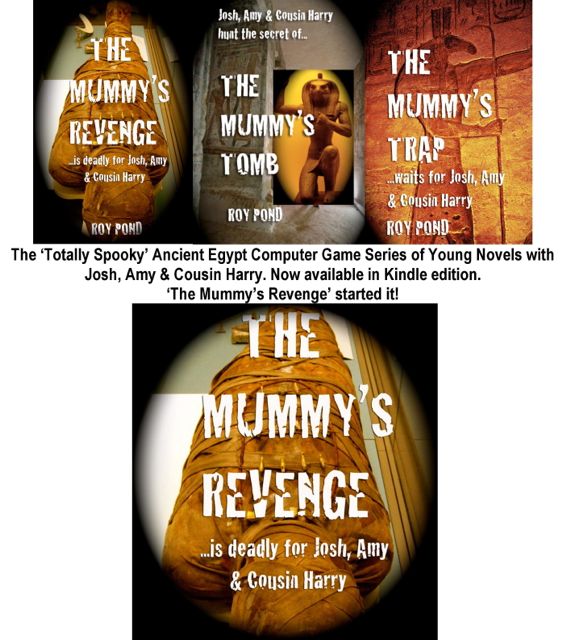
My series for young readers (written under the shortened name Roy Pond) was popular with schools in the US and Australia (THE MUMMY’S REVENGE… is Deadly” and “Who knows the secret of THE MUMMY’S TOMB.”). So too have been The Tomb Travellers series and of course ‘The Princess Who Lost Her Scroll of the Dead;.
By way of explaining the appeal of ancient Egypt for children, in one of my adult novels (The Hathor Holocaust) the renegade archaeological hero, adventurer, theorist and blogger Anson Hunter, confesses in his blog:
Something about Egypt hit me as a child, as it does many thoughtful children; in my obsessive case, a broken family possibly accelerated an inward turn.
The look of ancient Egypt is not only remote and eerie to a child, but also, paradoxically, second nature. Take a look at any child’s sketches and paintings. They’re eerily Egyptian, capturing the visible essence of things. The human body is often shown side on in the Egyptian way, just as it appears in tomb paintings and carved on temple walls, the shoulders turned to the front so that both arms are revealed and one foot placed ahead of the other.
Objects –tables, piles of food and fruit, animals, trees – float mysteriously in the air with disregard for scale. Young people understand ancient Egyptian art and design instinctively. They get it. It’s how they see the world – eternal, free of time and perspective.
A child’s view of Egypt is precious, I’ve come to believe. It almost seems that only as a child can you truly enter the Kingdom of Phaaoh. A child loves Egypt’s tombs, underworlds filled with glowing mages, temples that shiver in the heat of the sun, pyramids terrifying in their size, smooth statues of pharaohs and queens in dark stone, goddesses with long tresses, gods with animal heads.
Young people also have a sunny love of life, just as the Egyptians did, and yet both share a dark, hidden world of mystery and magic where animals can speak and where powerful unseen forces outside of their control influence events.
Children know a place that older people forget, a shadowy underworld of animal-headed monsters and fearsome creatures. Young people love a secret, and what civilisation was so steeped in secrets and mystery as ancient Egypt, from its hieroglyphs and hidden tombs to its mummies and spells for the afterlife? When small children go to bed, to the little death-sleep at night, don’t they take their treasured possessions with them on their journey, their toys and dolls to accompany them into an afterlife of dreams?
And what of Egypt itself, pyramids and stone pharaohs carved out of mountains, and soaring temples? A place built, as if from a child’s imagination, for giants.
With the average age at death of Egyptians being in the twenties, a case can be made for saying that it was young people who built the wonders of Egypt.
Put a child in a sandpit and what will it soon start to build? A pyramid of sand.
And think of the scenes in Egyptian tombs, those walls and painted passages that fling their lengths hundreds of metres into a cliff. The decorated walls show feasting, families fishing on boats on the river, flowers, fields and animals. They are not places of gloom like a modern graveyard. They are filled with scenes as bright and colourful as any child’s nursery.
Ancient Egypt is a place of wonders where anything seems possible. Little wonder that so many young people fall in love with it for a lifetime.
A child’s Egypt has never quite let go of me either…


 |
| Amazon Kindle |

Friday, February 24, 2012
"Ancient Egyptian magic in fiction."
Did the ancient Egyptians call on malefic forces. Read this ancient Egypt adventure series and, like my renegade fictional Egyptologist Anson Hunter, you too may believe...
Magical - Egypt Efiction
Thursday, February 23, 2012
Did the ancient Egyptians use malefic forces? Egypt Efiction.
 |
| My renegade fictional Egyptologist Anson Hunter engages with dangers from the ancient past, at his peril. |
Curses of fiery destruction, plagues and pestilence have a long history. They go back much earlier than Jahweh’s curse upon Egypt in Exodus.
The first occasion occurred when Ra, Egypt’s sun god, hurled an execration upon a rebellious humankind and, in a hot rage, despatched the scorching Eye of Ra to destroy them, a holocaust sun in the form of the goddess Sekhmet-Hathor, a marauding lioness, her breath spreading pestilence and plague and her claws bringing death as she swept through Egypt in an orgy of killing.
Monday, February 13, 2012
Blog of The Renegade Egyptologist, Anson Hunter
 |
| My fictional Egyptologist hero Anson Hunter has his own blog |
It reads like a fiction-hero's stream of consciousness blog - a Nile River of consciousness... thoughts and theories of a controversial outsider in Egyptology and archaeology.
Anson Hunter says of himself in 'About Me':
My blog runs through my life like a stream of consciousness, or should I say, a Nile river of consciousness... I am described as having a beanpole elevation and my ex-wife said I have the shining eyes of a fanatic. I'm fascinated by the parallels of ancient Egypt and the faith-based religions. I am an Anglican, but God probably wouldn't agree, since I'm a contradiction who harbours some old fashioned Christian beliefs and yet also believes in unseen realities. As a phenomenologist I believe you have to engage with the sacred and grant value to ancient beliefs in order to grasp them. For some reason my controversial ideas about dangers from the ancient past have brought the intelligence community into my world...as well as New Age and new world order conspirators who take their inspiration from ancient Egypt and the mystery religions...

Thursday, February 9, 2012
THE GIRL ON THE TRAIN wore an ancient Egyptian bracelet
 |
| Was the alluring young woman on the train to London bait for an Egyptologist? |
SPEED blurred the Oxfordshire greenery flashing by outside the train window as Anson Hunter sat at work on a laptop.
“You won’t mind if I sit next to you,” the voice of a young woman said.
His fingers stopped tapping the keys.
A sultry young woman in black slid into the seat beside him.
Irksome. Did she have to box him in? There were other seats in the carriage. Still, it could be worse - a man. Not homophobia on his part, he reasoned, more a sort of bonhomie phobia, an aversion to garrulous fellow travellers who interrupted his theorising. He vastly preferred the more reserved company of females on trains, buses and aeroplanes.
He tried to ignore her arrival and continued writing the blog:
Anson Hunter’s Blog -The Other Egypt
The sun disc of Ra, symbol of life and searing death, was central to the mythology of the Egyptians. Ironically today in the twenty-first century, we are again obsessed with the sun, heart of the burning issue of climate change.
Our lives and our future revolve around the sun, just as they did in the most ancient times of Egypt.
And now I fear a return attack of an ancient, holocaust sun and the reactivation of an apocalypse of global scorching, plague and pestilence…
The new arrival brushed against Anson’s arm and he glimpsed a flash of jewellery on her wrist. He did not look at her, but kept working.
But now the letters on the keyboard dissolved and swam.
His glance swung aside to her bracelet, lingered there, then tracked up the arm and body of a curvy young woman dressed in black to dark eyes under amused brows and then travelled back down to the bracelet again.
Shining on her wrist was a solid gold, rigid bracelet, inset with images. Profoundly archaic. Undoubtedly authentic. The carriage seemed to give a judder as if jolted by a locomotive in a shunting yard. Synchronicity? Or was this a sign of what he feared? He met the eyes of the stranger.
“Genuine Egyptian?” he said.
She smiled. “I’m Egyptian born. But of Greek ancestry, like Cleopatra.”
“I meant the bracelet.”
“You noticed it before you noticed me,” she said.
“I’m in the ancient Egypt trade.”
She sighed. “Yes, this is Egyptian. And I’m Alexia.”
His mind raced ahead of the train. Where was this going? She had ambushed him to show him the relic. Why? Because of his obsessive theorizing on the Internet? Recollections of a notorious event in archaeological history flashed through his mind like the country house in a field outside the train window.
The Dorak Affair.
A British professor of archaeology, James Mellaart, while travelling on a train to the port of Izmir in Turkey, noticed a bracelet on the arm of an attractive young woman. The piece bore the typological style of jewellery found at Troy -the first glimpse of a tantalising treasure recovered from an unknown site. Mellaart had little difficulty in engaging her in conversation and she introduced herself as Anna Papastrati. Yes, this bracelet was part of an ancient collection and she had more to show him if he really wanted to see it.
Under conditions of secrecy, Anna took the professor back to her apartment in Izmir. Here she revealed evidence of a staggering hoard, bronze-age objects from an Anatolian seafaring civilization neighbouring the Trojans that existed at the time of the Egyptians, four and a half thousand years ago. He saw statuettes of an electrum goddess and her handmaidens, fabulous golden jewellery, swords, daggers and ceremonial axe heads, including a sheet of gold embossed with hieroglyphs identifying Pharaoh Sahure, revealing early links with Egypt.
Mellaart must have felt the breath of good fortune on his neck, yet doubtless he could scarcely breathe. Might he borrow an object or two, take photos?
No. Anna was firm. She was not yet ready to release the story of the collection. But she would permit him to stay and make drawings of the artefacts, so long as he agreed to an embargo. He must wait for her approval before releasing information about the find. Mellaart agreed readily to her terms. He stayed with Anna for almost four days, making drawings of the artefacts.
“I need to take a closer look,” Anson said to the attractive stranger sitting beside him on the train to London.
“Not at me, I’m sure you mean. You’re more interested in this.”
He sized up his new travelling companion. Fair skinned yet darkly alluring. Yes, she fitted the bill. A little daring and mysterious.
She held up her arm for his inspection and he caught a wisp of perfume as he cradled it in his hand and drew it closer for scrutiny. The arm felt cool and creamily soft in texture.
The heavy gold bracelet was hinged on a gold pin, two half-cylinders that clipped together in a band, another gold pin forming the clasp. On alternate panels were turquoise inlaid images of Hathor in a very early form, a female face, cow-eared and horned, and beside each Hathor-head an image of her alter-ego, Sekhmet, a lioness in fiery red carnelian.
It was as jolting as seeing a snake coiled on her arm.
The implications made his thoughts blur like the passing greenery.
History, or a sensational episode of it, was repeating itself…
(Excerpt from The Hathor Holocaust)

 | Goodreads 5 and 4 star |

Monday, February 6, 2012
"Totally Spooky" - the ancient Egypt computer game series of young novels - Now on Kindle

Totally spooky!!
“This book is great! This book had me spooked until the very end. I advise against reading it at night unless you're practically fearless. It makes you want to read until the very last word. I don't scare easily, but this book managed to scare me pretty bad. Plus, it's one of those books that you can read and re-read again and again. It's a great, scary book, that pulls you right into the action and doesn't let you out until you finish it. I recommend it to anyone that likes to be scared.”
Amazon Review: 4.0 out of 5 stars |
| Discover Cousin Harry's totally spooky Egypt computer games... |
Saturday, February 4, 2012
BOOK SCENE: Anson Hunter recites Egypt’s Book of the Dead to avoid certain death...
 |
| "I would enjoy watching the scene where Anson Hunter recites a prayer from one chapter of the Book of the Dead to avoid certain death..." Reviewer |
“The plot unfolds like a box office hit… I would enjoy watching the scene where Anson Hunter recites a prayer from one chapter of the Book of the Dead to unravel the engineering secrets of Ancient Egypt and try to escape from certain death in the entrails of the Devourer” – Egypt Then and Now
When the ground stopped shaking, they shone their flashlights around the chamber.
They were trapped inside a sealed heart of Egypt's great Lost Labyrinth, with no way back or forward.
Our hearts have failed the test. We have been found sinful, the thought hit Anson. We’re stuck in the heart of the tomb.
"I think we've just had a coronary shut down," he informed them. He looked at Kalila, then at the Coptic monk Daniel and his nephews. “Any ideas?”
"There must be some mechanism that opens it again,"Daniel said. "We must find it! Start looking, I suggest.”
They all joined in a search of the walls and floors, as they hunted for hidden levers or mechanisms that might open the doors, pressing individual blocks of stone, running fingers between cracks.
Sound above their heads put a stop to their efforts.
Something was happening in the ceiling. Anson listened. Hissing sounds. Small apertures had opened in the roof. Red streams ran softly into the chamber.
"Blood!"
"Not blood, after three thousand years." Daniel bent and scooped up a handful. He sniffed it. "Clay dust," he muttered.
It wasn't blood, but it could kill them just as surely as any liquid.
"It's symbolic blood, dry red clay from Elephantine,” Anson said. “The red is haematite, iron oxide. In ancient legends red clay often took the place of blood when mixed with wine or water. I think this dust represents the blood of Osiris."
"If we don't get out of here soon, it will choke us," Kalila said, giving voice to their fears.
They redoubled their efforts to find a lever. They ran their hands like nervous spiders over the walls.
The powder-blood flowing into the heart gathered in piles around their feet. The streams were running faster.
Kalila coughed. Fine dust filled the air. It would suffocate them long before it covered their heads.
"Keep looking!" Daniel urged them.
"There’s nothing," Kalila said.
"It is a mechanical trap," he insisted. "There must be something that will open it again."
Anson watched the streams of red dust particles falling from the ceiling. Then the world brightened as an idea floated down to him.
“As light as a feather?” he said. “What human being is so innocent? That’s it. No human being is that light.
We have to change ourselves, take on the forms of the gods. Before the dead can go on to take their place in the realm of Osiris, they had to say a spell that would change the parts of their bodies into the parts of gods.”
His eyes swept around the walls at the carved reliefs of the gods and goddesses, the torch beam turning the dust into clouds of blood.
Red dust piled up around their ankles. Anson felt the dust tickling his lungs. Daniel covered his mouth with his shirtsleeve, spluttering.
“What were the parts that must change?” Anson said.
He banged his forehead with the palm of her hand, trying to jolt his memory.
“Think, brain. Think. The Chapter of Coming forth by Day. The Papyrus of Ani...”
The red dust turned the air into a blood storm, as if blood had already filled the chamber to its roof.
“There’s no way to open that door,” Daniel said.
“Then we’ll all die, unless we can think of a way,” Kalila said.
“I’ve got it, I think. We’re going to need a bit of divine help,” Anson said. The powder blood billowed up into their faces and seeped into their clothes. He waded through it, sinking up to his ankles.
“Am I right?” he said, with a rasp of dust in his throat.” Is there an order to this?” He reached the wall.
“ The dead must take on the parts of the gods. Which gods and in which order?”
The powder was in their lungs and it tasted metallic like blood.
Anson recalled the prayer of the papyrus of Ani.
“My eyes must become the eyes of Hathor...” he said.
Hathor stood with a crown of cow horns and a solar disc between them, her lithe form rippling in the blocks of stone. He reached up to Hathor’s face and pressed the eye. A block grated back into the wall.
He twisted, face alight with relief. “I haven’t lost my touch. We’ve got to choose the parts of the gods and so change ourselves. Each part of a human body has to become a part of a god... The eyes of the dead must become the eyes of Hathor, his face the face of Ra, his cheeks the cheeks of Isis, the backbone that of Seth, the buttocks of Horus, the phallus of Osiris, the thighs of Nut, the feet of Ptah...”
Each part had to change into a god.
Anson went around the wall, brushing past the others who had covered their faces and were trying to sift the dust-laden air through their fingers.
Powder blood rose past their knees to their thighs…
Excerpt from "The Smiting Texts", first in the Egypt adventure thriller series of novels (Amazon paperback and KINDLE)


Subscribe to:
Posts (Atom)
-
 (Ancient action - excerpt from DYNASTY ZERO on Amazon Kindle ) I turned to stone in the alley, along with the small girl beside m...
 -
 Reader 1. “Completely blown away” Just finished reading this book and am completely blown away. I couldn’t put the (b-----) thing down, onl...
 -
 Ancient Egypt mythology breaks into modern day mystery Ancient Egypt resurrected... 3 Egyptian mythology-driven mystery thrillers set in ...
 -
 Maybe revisiting an old love right now may be just the shot in the arm you need. For all its colonialist assumptions and 'date...